A property manager lays three repaving quotes side by side on a desk. Same lot, same square footage on paper, and the totals are nowhere near each other. The lowest one never mentions removing the old pavement. The middle one assumes the base underneath is fine. The highest one includes drainage corrections that nobody else priced. None of the contractors is lying, but they are not pricing the same job, and the budget built from any one of those quotes is going to miss.
That gap between quotes is where most repaving budgets go wrong, and it is fixable before a single contractor is called.
In this article:
- Set the Budget After the Assessment, Not Before
- What Actually Drives the Price of Repaving a Parking Lot
- How to Compare Quotes So You Are Pricing the Same Job
- Why Base and Drainage Line Items Decide Whether the Budget Holds
- Budget for the Repairs That Delay the Next Repaving
- Contingency: What to Hold Back and Why
- Budgeting for Access, Safety, and a Lot That Stays Open
- Start Your Repaving Budget With a Real Assessment
Set the Budget After the Assessment, Not Before
Most owners start with a number and ask a contractor to fit the work inside it. That is backwards. A parking lot can need anything from sealing and spot repair to a full rebuild, and those are different projects with very different price tags. The only way to know which one a lot needs is to look at what is underneath the surface.
A proper assessment goes beyond walking the lot and counting potholes. It looks at whether cracking is staying at the surface or has reached the base, where water is pooling and refreezing, how the lot drains to its catch basins, and how the pavement is holding up in the places that take the most traffic, like entrances, loading areas, and turning lanes. That picture decides the treatment, and the treatment decides the budget.
If you take one counterintuitive piece of advice from this article, it is this: spend a little time and effort on the assessment first, even if it feels like it delays the budget. An owner who sets a figure before the assessment usually ends up revising it upward halfway through the project, which is a much harder conversation than getting it right at the start.
What Actually Drives the Price of Repaving a Parking Lot
Repaving costs are driven by a handful of variables, and the same lot can land in very different places depending on how they stack up:
- The size of the lot and how much of it needs work, since a full-lot project and a partial one are priced very differently
- Whether the existing surface is milled and overlaid, or removed entirely down to the base
- The condition of the base, which is the biggest unknown on most projects
- Drainage and grading work needed so water leaves the surface instead of sitting on it
- The type of traffic, since lots carrying delivery trucks need a different build than lots carrying only cars
- Curbs, catch basins, and concrete work that tie into the pavement
- Line striping, accessible stall layouts, and signage
- Access for equipment and how much phasing the site requires to stay open
- The timing of the work within the paving season
When a quote looks surprisingly low, it is worth checking which of these it quietly leaves out. Our parking lot paving page explains how each of these shows up in a real project scope.
How to Compare Quotes So You Are Pricing the Same Job
Getting several quotes is sound advice, but only if the quotes describe the same work. Before comparing totals, make sure each contractor was shown the same lot, the same scope, and the same expectations, and that each quote spells out the following:
- Whether old pavement is removed or overlaid, and why
- How the base is being prepared, repaired, or replaced
- The depth and number of asphalt layers going down
- Drainage, curb, and striping work, listed separately instead of lumped together
- The proposed schedule and how the lot stays accessible during the work
Experience and materials matter as much as the total. A quote that is lower because it skips preparation is not a saving, it is a deferred expense that comes back as early failure. Vince at Empire Paving, whom one client credited with a quote that came in right on budget, tells owners to ask every contractor to price the same written scope, so that differences in the totals reflect real differences in the work instead of different assumptions.
Why Base and Drainage Line Items Decide Whether the Budget Holds
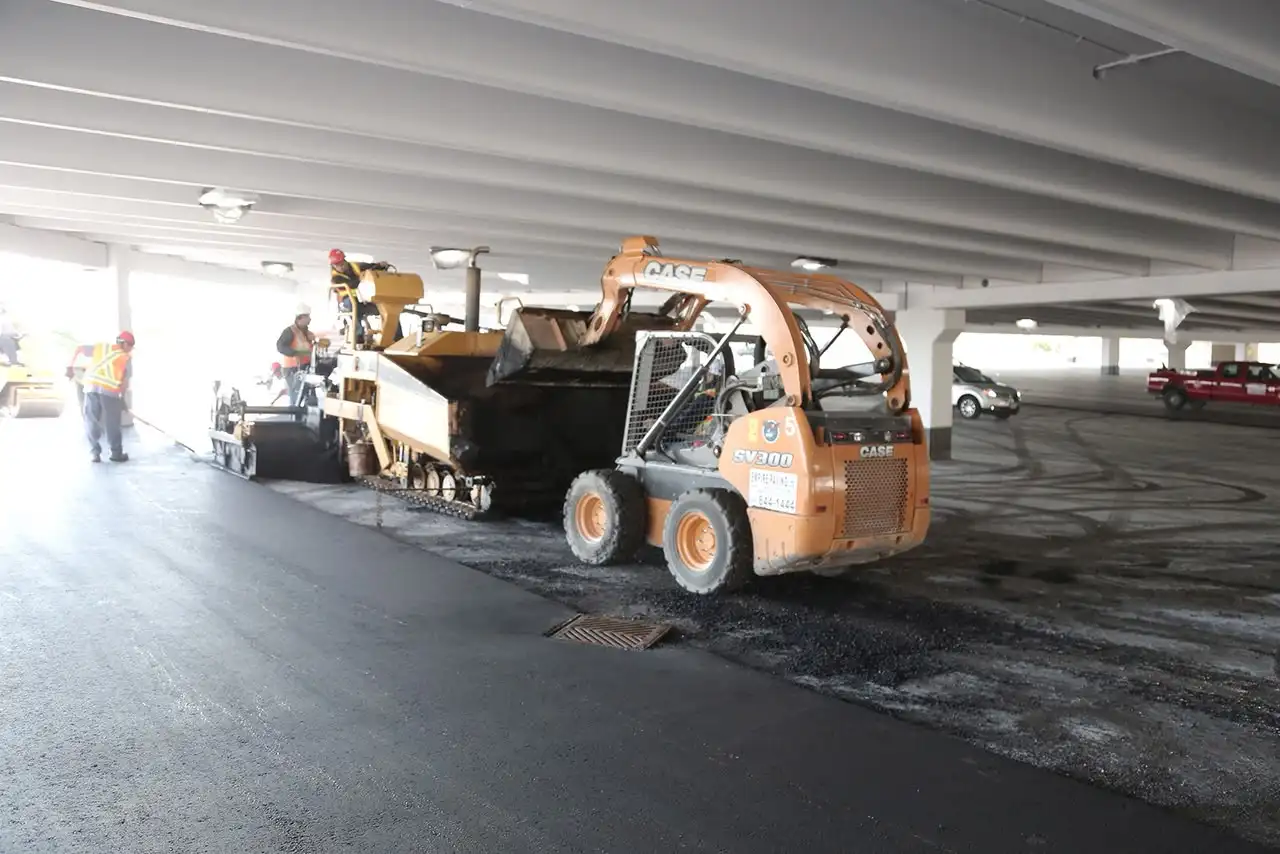
The asphalt surface is the part everyone sees, but the base and drainage are what decide how long the new surface lasts. Water that gets into a weak base softens it, and every freeze and thaw after that widens the damage. A new layer of asphalt placed over a base that has already failed will crack along the same lines within a few seasons, no matter how good the asphalt is.
That is why preparation belongs in the budget as its own line item and not as an afterthought. Removing failed pavement, repairing or replacing base material, regrading low spots, and correcting drainage all cost money up front, and all of them protect the investment in the surface that goes on top. Where curbs, gutters, or catch basins are part of the problem, our concrete work services handle that scope alongside the paving, so the pavement and its drainage are designed together.
Budget for the Repairs That Delay the Next Repaving
Repaving is not a one-time line item. A lot that gets crack sealing, sealcoating, and prompt pothole repair on a regular cycle will usually reach its next full repaving later than one that is left alone, and that deferral is the cheapest money an owner can find. The reverse is also true: skipping routine maintenance for several seasons often turns a surface repair into a base repair.
Build maintenance into the multi-year budget alongside the repaving itself. Investing in better materials and skilled labour costs more up front, but it can reduce how often the lot needs to be redone. Our asphalt repair and maintenance page covers the treatments that fit into that cycle. For larger properties, it also helps to ask whether the lot can be repaved in sections across more than one budget year, so the cost is spread out and the worst areas are handled first.
Contingency: What to Hold Back and Why
Every repaving project has some unknowns, and most of them sit below the surface. Once old pavement comes off, the base is exposed, and it sometimes turns out to be in worse shape than the visible surface suggested. A contingency reserve covers that situation without forcing a mid-project scramble for approval.
The right size for that reserve depends on how much you already know. A lot that has been assessed thoroughly, with the base condition understood, needs less of a cushion than one where the underlying condition is still a guess. Ask each contractor how their quoting process handles unknowns, and whether they identify likely risks before the work begins instead of after.
Budgeting for Access, Safety, and a Lot That Stays Open
A repaving budget that only covers asphalt misses the cost of running a property while it is torn up. Customers and tenants still need somewhere to park, deliveries still need to reach loading areas, and walkways still need to be safe. Plan for alternate parking, temporary signage, barriers, and the extra scheduling that comes with phasing the work in sections instead of closing the whole lot at once.
Phased work can take a little longer, but it is often the difference between a project that disrupts business and one that barely registers. Ask contractors how they would phase your specific lot, and include that plan in the scope you compare.
Start Your Repaving Budget With a Real Assessment
If you are planning a repaving project for a commercial, industrial, or institutional lot in the GTA, the most useful first step is an assessment that tells you what the lot actually needs. Empire Paving has been assessing and repaving parking lots across the GTA since 1976, and a free consultation and estimate gets you a written scope you can use to build a budget that holds.
Request Your Free Assessment
Call Empire Paving at 416-644-1444 to schedule a parking lot assessment before you set your repaving budget.


 We were very pleased with the professional job done by Empire Paving this fall.Luciano and his team were very reliable, knowledgeable and able to handle all issues that arose during completion of this project. We would highly
recommend Empire Paving for any paving job!