Toronto is also one of the few places where the paving standard is public. The City publishes its own construction specification for hot mix asphalt paving, TS 310, which spells out what a properly placed road looks like: the ground cannot be frozen, the air has to be warm enough, and the mix has to be compacted before it cools. We build with that same discipline on every Toronto road project. For the full scope of what we do across Ontario, see our roadway paving services page.
Empire Paving has served Toronto and the wider GTA since 1976, with in-house crews and equipment that handle excavation, grading, asphalt, and finishing under one schedule.
Why Toronto Owners and Facility Operators Invest in Properly Built Roads
- Truck traffic is concentrated in Toronto’s industrial districts, and a road built for passenger cars fails quickly under repeated heavy loads
- A strong base keeps water out, which matters in a city where freeze-thaw cycling works on every small crack
- Phased paving keeps tenants, deliveries, and production running instead of closing a whole route
- A road designed for the traffic it carries needs fewer emergency repairs and lasts longer between resurfacing cycles
- Clear grading and drainage protect the surface and the surrounding property from pooling water
Roadway Paving Services We Offer in Toronto
- Asphalt Road Construction: New private roads, site roads, and commercial roadways built from design through execution, with the base and drainage sized to the traffic they will carry.
- Resurfacing and Overlay: Renewing aging roads whose base is still sound, which extends their life at a fraction of the disruption of a full rebuild.
- Pothole and Crack Repairs: Timely repairs that stop water from reaching the base. See our asphalt repair and maintenance page for details.
- Line Marking and Traffic Solutions: Clear, durable markings for lanes, stop bars, and crossings, installed once the surface is ready for traffic.
- Drainage and Grading: Shaping the road bed to move water to catch basins, protecting the pavement and the structure beneath it.
How Toronto Winters and Cold Snaps Decide the Paving Season
Toronto roads go through winter freezing, spring thaw, and temperature swings that open small cracks and let water into the base. That repeated cycle is what turns a hairline crack into a pothole by spring. It is also why asphalt cannot simply be laid whenever a property owner is ready.
The City’s own specification sets the limits. TS 310 bars paving on a frozen roadbed and calls for surface course placement when the surface air temperature is at least 7°C and rising, with binder courses requiring a lower minimum. Below those conditions the mix cools before it can be compacted to the density it needs, and the resulting surface holds water and fails early. For a road, that means the working season runs from late spring through early fall, and late winter is the right time to assess and book.
Warning Signs a Toronto Road Needs Paving Work
- Alligator cracking or ruts along the wheel paths, usually a base problem rather than a surface one
- Potholes that return in the same location after repeated patching
- Edge breakup where the pavement meets gravel, grass, or an unprotected shoulder
- Water that lingers on the road after the rest of the site has dried
- Dips or settling around catch basins and utility covers
- Faded lane markings and stop bars at turning points and intersections
Why Base and Process Prep Matter More Than the Asphalt Itself
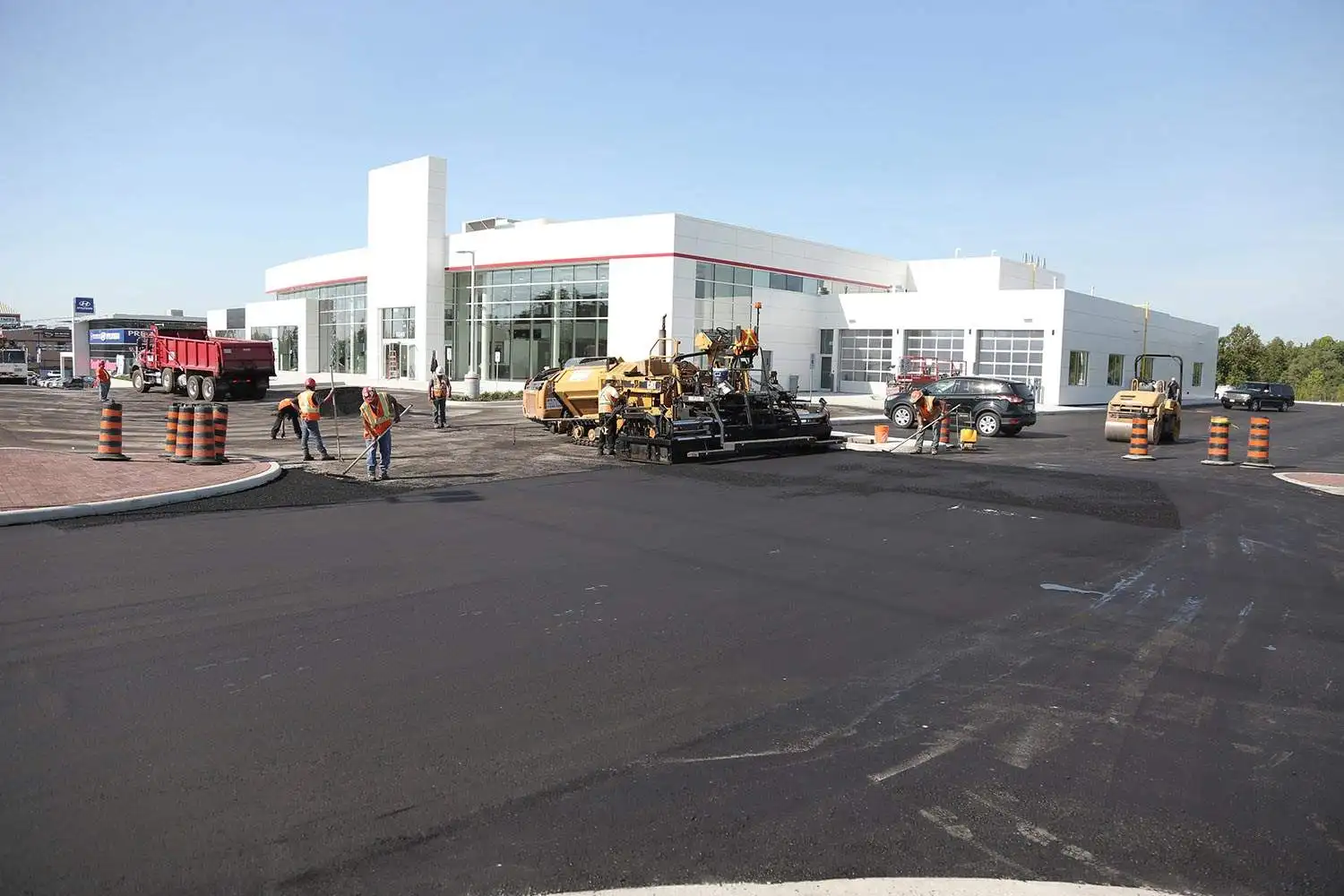
The surface is the last thing placed and the first thing blamed, but most road failures start underneath it. Our process on a Toronto roadway follows the same discipline the City’s specification expects:
- Site assessment and layout, reviewing existing grades, drainage, and utilities before any machine moves
- Excavation and sub-base stabilization, so soft or frozen-damaged soil is replaced before the granular base goes in
- Granular base placement and compaction in layers, so the road does not settle under traffic
- Asphalt placed in base and top lifts, with the joints tacked and the mix compacted while it is still hot enough to densify
- Verification of compaction, since TS 310 calls for nuclear density gauge testing along each lane
- Curing before traffic, because the City’s specification does not allow traffic on a course until it has cooled
What Makes Roadway Paving Different in Toronto
The City classifies every street it owns into one of five classes: local road, collector road, minor arterial, major arterial, and expressway. Each class carries a different traffic load, and the classification drives everything from winter maintenance priority to truck restrictions. A private road is not on that list, but the same logic applies. A road built for a few vehicles an hour and a road built for a steady stream of trucks are different structures, and we scope the base and asphalt depth to the second case, not the first.
Toronto also has 23 designated Areas of Employment, and the five largest are Rexdale-Airport, South Etobicoke, Downsview, Highway 400, and Tapscott, according to the City’s Toronto Employment Survey. Roads in and around those districts carry the manufacturing and distribution traffic that wears pavement fastest. Downtown and inner-city sites have the opposite problem: tight access, limited staging space, and little room to close a lane. We plan each Toronto job around which of those conditions applies, rather than applying one approach everywhere. For the broader picture of our work in the city, see our Toronto service area page.
A Typical Toronto Roadway Project
A common roadway project we handle in the city is the repaving of a private industrial access road in phases, so production, deliveries, and employee access are not shut down while the work is underway. One industrial client described a two-phase repaving at their facility this way: “They were able to work around our production schedule, and ensured that we had no operational disruptions.” The same phased approach applies to commercial and institutional sites, where closing the only access route is not an option.
Extending the Life of a Toronto Road
- Crack sealing before winter, so freeze-thaw cycling has less to work with
- Keeping catch basins and drainage paths clear, since standing water is the fastest way to weaken a base
- Prompt pothole repair, because a small pothole left through a Toronto winter is usually much larger by spring
- Periodic restriping so lane markings and stop bars stay visible
- Eco-conscious material options, discussed during the site assessment where the project specification allows
Built on Experience and Compliance
- Specification-Driven Scope: We scope each road to the specification the owner or agency requires, including the City’s published standards where they apply, rather than building to a generic template.
- In-House GTA Crews: Our own crews and equipment handle Toronto projects directly, from excavation through line painting, without waiting on subcontracted labour.
- Certified and Compliant: Textura certified, ComplyWorks member, Teamsters affiliated crews, and members of the Toronto Construction Association (TCA), with project work completed to the QHSE requirements of major industrial clients.
- Established Track Record: Serving Toronto and the GTA since 1976, with a portfolio of verifiable commercial, industrial, and institutional client testimonials.
Frequently Asked Questions About Roadway Paving in Toronto
Do you pave private roads and industrial site roads in Toronto?
Yes. Private roads, industrial site routes, commercial access roads, and institutional campus roads are the core of our roadway work in Toronto. We handle the project from excavation and base preparation through asphalt, curb work, and line painting.
What does it take to repave a private road in Toronto?
The road is assessed first, including the base, drainage, and traffic load. From there the work follows a set sequence: excavation where needed, sub-base stabilization, a compacted granular base, grading, and asphalt placed in layers. Roads that will connect to or be turned over to a public agency have to meet that agency’s requirements, so we confirm the specification before scoping the work.
Can roads be paved in a Toronto winter?
Not properly. The City’s own TS 310 specification bars paving on a frozen roadbed and requires warm enough air for the mix to be compacted before it cools. Winter is the right time to inspect a road and book the project for the earliest workable window in spring.
What is the difference between resurfacing and rebuilding a road?
Resurfacing replaces the worn top layer when the base underneath is still sound. Rebuilding removes the pavement and base down to the point where the failure begins. A site assessment tells us which one the road needs, and rebuilding a road that only needs resurfacing is an unnecessary expense, just as resurfacing a failed base will not hold.
Can you keep truck access open while the road is being paved?
In most cases, yes. We phase the work in sections and coordinate access with the property so deliveries, production, and employee traffic can continue where the site allows it.
What factors affect the cost of roadway paving in Toronto?
The length and width of the road, the condition of the existing base, the depth of granular base and asphalt required for the traffic load, drainage and grading work, site access for equipment, and how much line painting and curb work is involved all factor into the estimate. We provide a detailed, no-obligation quote after an in-person site assessment.
Get Your Transparent Roadway Paving Estimate in Toronto Today
Call Empire Paving at 416-644-1444 to schedule a roadway assessment anywhere in Toronto, from the Rexdale-Airport and South Etobicoke employment areas to commercial and institutional sites across the city.
Empire Paving Limited, 50 High Meadow Place, Toronto, Ontario M9L 2Z5
GET A QUOTE

Get a FREE Paving
Consultation & Estimate
Call Us at 416-644-1444 or simply fill out the form and one of our paving experts will be in touch with you shortly...



Project Gallery

Project completed

Experienced Team

Happy customer

Sucessful Rating